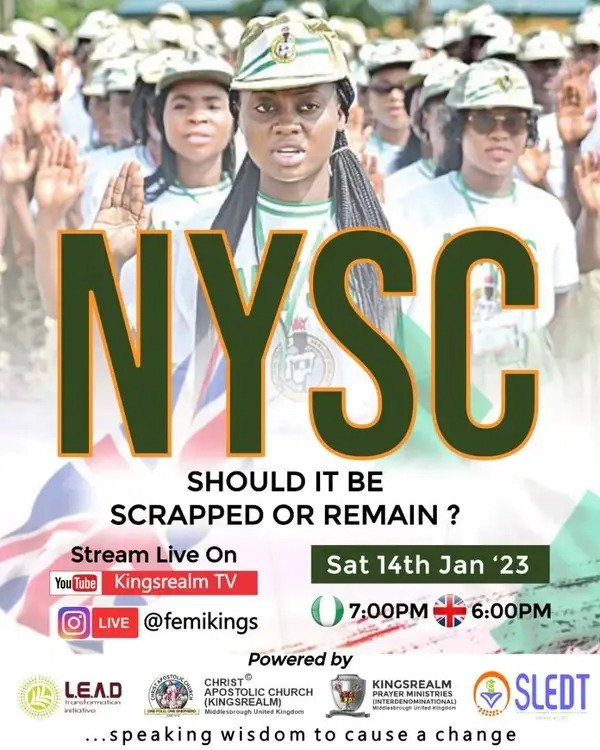
A Programme Born From the Wounds of War
To understand the National Youth Service Corps, you have to go back to where it began.
The NYSC was established in 1973, just two years after the end of the Nigerian Civil War. The idea was both practical and idealistic: take young graduates from across the country, send them to states far from their home regions, and let them live, work, and build alongside Nigerians who look different, speak different languages, and grew up in entirely different circumstances. The hope was that shared service would build shared identity — that a Yoruba graduate posted to Kano, or an Igbo engineer sent to Sokoto, would return home having understood something about their country that no textbook could teach them.
It was, at its core, a nation-building project dressed in khaki and boots. For decades, that project produced real results. Doctors served in underserved rural communities. Teachers reached schools that would otherwise have had none. Engineers applied their skills to infrastructure projects in regions that needed them most. And hundreds of thousands of young Nigerians built genuine friendships, relationships, and professional networks across ethnic and regional lines that the country’s history had made difficult to cross.
That is a real legacy. It deserves acknowledgement before any honest critique begins.
Where the Scheme Has Failed Its Own Promise
And yet. For every story of transformation and national integration that the NYSC has produced, there are stories of a different kind that have grown louder and more urgent with every passing year.
The security crisis
Posting young graduates to states experiencing active conflict — banditry, insurgency, communal violence — has had consequences that are impossible to dismiss. Corps members have been killed. Families have been devastated. And the question that follows each tragedy is the same: was this posting necessary? Was this risk justified? Was the state in any real position to protect this young person, who was asked to serve in its territory?
The employment illusion
The NYSC was designed for a Nigeria where a one-year service posting was a brief interlude between graduation and a thriving job market. That job market no longer exists in the way it once did. Today, many corps members spend their service year watching the clock, doing work that has no meaningful connection to their training, and emerging on the other side into the same unemployment queue they would have joined without the year’s delay. The scheme delays the inevitable without changing it.
The corruption and logistics failures
Allowances are paid too late or not at all. Camp conditions range from uncomfortable to genuinely unsafe. Administrative processes that prioritise bureaucratic compliance over actual impact. Postings that feel arbitrary rather than strategic. These are not occasional complaints; they are the consistent experience of a significant portion of the hundreds of thousands of graduates who pass through the scheme every year.
The integration question
Nigeria is now a different country from the one that needed the NYSC in 1973. It is more connected and, in some ways, more fractured, by new fault lines that a posting to a distant state does not automatically bridge. Whether a mandatory one-year service programme is still the right instrument for national integration in 2024 is a genuinely open question.
The Case for Keeping NYSC
Here is something that often gets lost in the scrap-or-keep debate: the NYSC, for all its failures, is still doing things that matter in communities across Nigeria. Corps members are staffing primary health centres in rural areas that would otherwise have no medical personnel. They are teaching in schools where the alternative to an NYSC teacher is an empty classroom.
They are running community development projects — boreholes, sanitation programmes, agricultural demonstrations — that leave real, physical improvements behind when their service year ends. Strip the NYSC away entirely, and those communities lose something. The question is not whether to value what the scheme provides; it clearly provides something, but whether the current structure is the most efficient, most humane, and most impactful way to provide it.
There is also the integration argument, which should not be dismissed too quickly. Imperfect as the posting system is, it continues to create cross-cultural encounters that would not otherwise happen organically. A Lagos-born graduate who spends a year in Plateau State, makes friends, eats different food, learns a few words of a different language, and navigates a different social context — that person returns home slightly less provincial than they left. In a country with Nigeria’s history, that matters.
NYSC Should Be Reformed, Not Removed
The most intellectually honest position on the NYSC is probably neither abolition nor uncritical defence — it is a call for deep, structural reform backed by political will that has, so far, not materialised.
What might serious reform look like?
Voluntary posting to conflict zones: No corps member should be compelled to serve in an area where the state cannot guarantee a basic standard of security. This is not a soft position; it is an ethical one.
Skills-aligned placements: A doctor should serve in a health facility. An engineer on an infrastructure project. A data scientist in a government agency that can actually use their skills. The gap between what corps members are trained to do and what they are asked to do during service is a waste of human capital on a national scale.
Meaningful allowances: The monthly stipend paid to corps members has not kept pace with inflation in any serious way. Asking young graduates to serve the nation while paying them a sum that does not cover their basic needs is not a service compact; it is an exploitation compact.
Community integration, not just posting: Rather than treating integration as a byproduct of geography (for example, you are from Anambra, so we will send you to Kebbi), the scheme could design structured intercultural programmes that actively build the relationships and understanding it claims to be fostering.
Accountability for outcomes: What does a successful NYSC year actually look like? How is it measured? What happens when placements fail their stated purpose? These questions deserve answers that go beyond attendance records and passing-out parades.
So, Should the NYSC Be Scrapped?
Here is the truth: there is no clean answer to this question. And anyone who tells you there is, is probably not grappling with the full complexity of what the NYSC represents and what its removal would mean.
Scrapping it entirely would remove a programme that, for all its failures, is still delivering services to underserved communities and still creating, however imperfectly, the cross-cultural encounters that Nigeria needs more of. It would also send a signal that Nigeria is incapable of fixing its own institutions: that when something breaks, the only option is to throw it away. Keeping it exactly as it is (unreformed, under-resourced, and structurally unchanged) is also indefensible. It asks young Nigerians to accept risk without protection, service without fair compensation, and a year of their lives in exchange for outcomes that are, at best, inconsistent.
The real question is not scrap or keep. The real question is: does Nigeria have the political will and institutional capacity to do what it would actually take to make the NYSC worthy of the young people it asks to serve?…That is a harder question. And it is exactly the kind of question that deserves a real, honest, unscripted national conversation.
For partnership and support inquiries, contact LTI directly.