What a Child Has Never Seen, They Cannot Dream of Becoming
There is a version of education that happens inside classrooms — lessons written on blackboards, textbooks passed around, exams that test what has been memorised. That version of education matters. But there is another kind of education that no classroom can fully replicate: the education of experience. Of standing somewhere you have never stood before. Of seeing something with your own eyes that you had previously only heard about, or never heard about at all.
For many children growing up in rural communities across Nigeria, the boundaries of their world are drawn early. Not by lack of intelligence or ambition, but by geography, by poverty, and by the simple fact that nobody has ever taken them beyond the familiar edges of their community to show them what else exists. This is what Lead Transformation Initiative’s Smart Farmers’ Kids programme understands, and that drove the decision to take a group of farmers’ children from Mariwo community on an excursion to Akure Airport.
Smart Farmers’ Kids: More Than Agricultural Training
The Smart Farmers’ Kids programme is often understood primarily through its agricultural lens. It introduces rural children to container farming, practical food production, and the dignity of working the land. But from the very beginning, the programme’s objectives have always been broader than farming alone.
One of its core stated aims is to change the worldview of these children to stretch the boundaries of what they believe is possible for themselves, to form their characters around a sense of expansive possibility rather than inherited limitation, and to ensure that where they come from does not determine the ceiling of where they can go.
The Smart Summer School component of the programme is a direct expression of that philosophy. During school holidays, when many rural children might otherwise spend their time idly or working on the farm without any structured intellectual engagement, Smart Summer School keeps their minds active, curious, and open, and takes them places their village cannot take them. The airport excursion was exactly that kind of place.
The Day Mariwo’s Children Stood at the Edge of the Runway
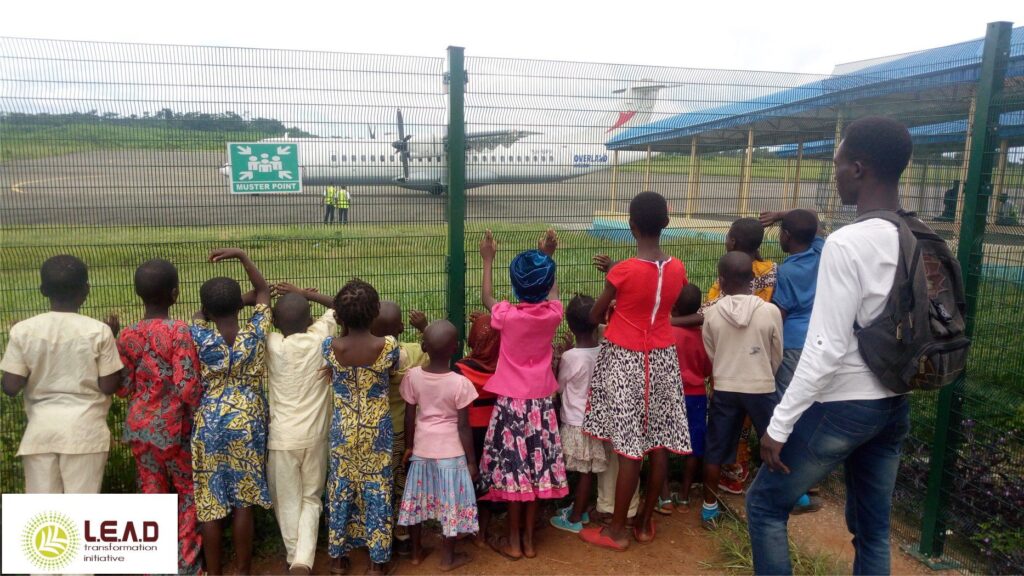
Picture it for a moment. Children from a rural community — children who wake up to the sounds of birds and farming activity, whose daily world is defined by the rhythms of village life — standing at Akure Airport, watching an aeroplane across the tarmac.
For many of them, it was the first time they had ever seen one up close. Not in a picture. Not in a film. In real life, enormous and impossible-looking, doing the thing that aeroplanes do. That moment of a child’s eyes going wide with something between disbelief and wonder is not a small thing. It is the moment a new possibility enters a young mind. The moment the world gets larger. The moment a child silently begins to ask: Could I ever do that? Could someone like me belong in a place like this?
The answer that the Smart Farmers’ Kids programme gives is a firm, unambiguous yes.
An Unexpected Encounter: A Director, a Departure Gate, and a Life Lesson
Sometimes the most powerful moments are the ones that are not planned. As the children were taking in the airport environment, they had an unexpected encounter. Titilayo Femi Kings, LTI’s Director of Operations and Strategies, was passing through Akure Airport in transit. When he saw the group of Mariwo children on their excursion, the moment became something more than a coincidence.
The children expressed their gratitude for the opportunity LTI had given them. And before boarding the flight, the Director paused to speak directly to them. His words carried a message worth sitting with: The poor status of their respective backgrounds should not put or keep their backs on the ground, but should instead serve as a launchpad for their development and for the development of the Mariwo community as a whole.
That message, delivered at an airport by a man who was about to board a flight while speaking to children who had never seen one up close, had a context that amplified its meaning enormously. It was not an abstract speech about resilience. It was a living demonstration of it, standing right in front of them, in a blazer, about to walk through a gate and fly somewhere.
The children did not just hear the message. They saw it. And that is a different thing entirely.
What the Airport Taught Them That the Classroom Could Not
Beyond the personal encounter with the Director, the visit to Akure Airport had a structured educational dimension that expanded the children’s understanding of the world in important ways.
The management of the airport took time to educate the children on two things that rarely enter the consciousness of rural children in Nigeria: the functions of an airport and the career opportunities available in the aviation industry. For children whose exposure to career possibilities had largely been limited to what they could observe in their immediate community was a revelation.
Aviation is a world that seems to belong to other people, other cities, other lives. The airport management’s decision to speak directly to these children about careers in their industry was an act of inclusion: a signal that this world is not closed to them, that there are roles within it that people from communities like Mariwo can aspire to and achieve. Air traffic controllers, ground engineers, flight attendants, airport operations managers, cargo logistics specialists, and lots more. These are not just job titles; they are invitations. And for children who had never previously received that invitation, hearing it spoken aloud in the very space where those careers happen is the kind of experience that quietly rewires what a child believes is meant for them.
Why Exposure Is One of the Most Powerful Interventions in Rural Child Development
Development practitioners and education researchers have long understood something that common sense confirms: children cannot aspire to what they have never encountered. Aspiration is not purely internal. It is shaped by what a child has seen, who they have met, and what version of the possible has been made visible to them.
Children who grow up in cities absorb career possibilities passively, through the adults around them, the buildings they pass, the professions they encounter in daily life. A child in Lagos sees lawyers, architects, television presenters, and pilots simply by virtue of moving through an urban environment. Their sense of what is possible is constantly being expanded by proximity. Rural children do not have that passive exposure. For them, the expansion of possibility must be deliberate — built into the programme, planned into the calendar, driven by adults who understand that an excursion to an airport is not a field trip. It is an investment in a child’s imagination. And a child’s imagination is the raw material from which their future is made.
This is what the Smart Summer School airport excursion did. It made the invisible visible. It put the possible within touching distance. It said, without using those exact words: this world is yours too.
The Launchpad Philosophy: Turning Disadvantage Into Drive
The phrase that Titilayo Femi Kings used at the airport is worth returning to: the idea of a background as a launchpad rather than a burden. It would be easy to hear this as a motivational platitude. But there is something more substantive in it when you understand the context. Mariwo is a rural community. The children in the Smart Farmers’ Kids programme come from farming families, from households without consistent income, from a community that formal development systems have historically underserved. Their backgrounds carry real material disadvantages.
The launchpad philosophy does not deny those disadvantages. It reframes the relationship a child has with them. It says: the difficulty of where you come from, if you let it, can become the very thing that makes you more determined, more resourceful, more committed to building something better both for yourself and for the community that shaped you.
It is also an implicit commitment from LTI. A launchpad only works if there is infrastructure underneath it. LTI is working to be that infrastructure: providing the education, the exposure, the mentorship, and the consistent support that transforms potential into trajectory.
Quality Education and Reduced Inequalities, Made Tangible
The United Nations Sustainable Development Goals are sometimes critiqued as being too abstract. The airport excursion is a small but precise refutation of that critique.
SDG 4 calls for inclusive and equitable quality education and lifelong learning opportunities for all. Taking rural children to an airport and ensuring they receive meaningful learning while they are there is quality education. It is inclusive and equitable. It is exactly what SDG 4 is asking the world to do.
SDG 10 calls for reduced inequalities within and among countries. One of the most durable drivers of inequality in Nigeria is the gap in exposure and opportunity between urban and rural children. A child who grows up in Mariwo with no exposure to the world beyond their community enters adulthood at a significant disadvantage compared to their urban peers. Although it is not because of intelligence or work ethic, but because of access. Programmes like Smart Farmers’ Kids directly address that access gap. They are inequality reduction, one excursion at a time.
The Compounding Value of Every Experience Given to These Children
Here is the thing about experiences like the Akure Airport excursion: their value does not end the day they happen. It compounds.
The child who stood at the airport that day and watched a plane taxi toward the runway carries that image forward. It becomes part of how they see themselves and what they believe they are capable of. Years from now, when that child is making decisions about education, about careers, about whether to stay in Mariwo or venture further, that airport will be somewhere in the background of those decisions. A small but real expansion of what they considered possible.
Multiply that by every child in the Smart Farmers’ Kids programme. Multiply it by every excursion, every lesson, every encounter with a director boarding a flight who stops to speak words of encouragement. The cumulative effect on a generation of rural children is not small. It is the slow patient building of a community whose children grow up knowing that the world is larger than their village and that they have every right to claim their place in it.
Rural Children Are Not Behind, They Are Underexposed
The children of the Mariwo community are not deficient. They are not behind because they lack ability. They are underexposed, which is a completely different problem, and a completely solvable one. The Smart Farmers’ Kids programme, with its combination of agricultural skills, academic support, and deliberate exposure to the wider world, is proving that solution one child at a time. An airport visit. A director’s impromptu speech. An aviation officer explaining career paths to a group of children who had never been asked to consider them before.
These are the moments that development organisations rarely photograph with the gravitas they deserve. But they are the moments that matter most because they are the moments that quietly rewrite what a child from a rural Nigerian community believes is meant for them. And when a child’s belief expands, so does everything that follows.
For partnership and support inquiries, contact LTI directly.